Here is the last collection of Pilgrim Meditations. There are another 20 of them here. I offer them to you as a way to grow in your walk with God.
II Timothy 4: 7 I have fought the good fight, I have finished the race, I have kept the faith. 8 Now there is in store for me the crown of righteousness, which the Lord, the righteous Judge, will award to me on that day–and not only to me, but also to all who have longed for his appearing.
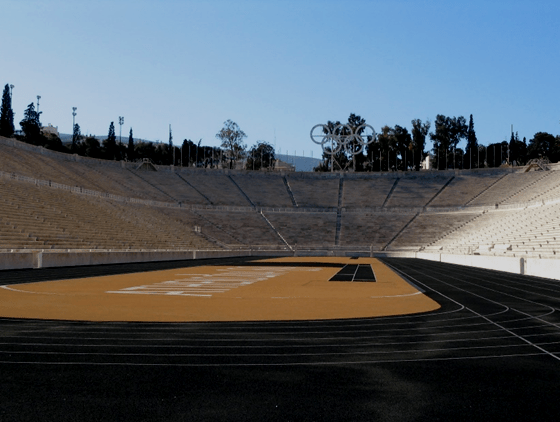
In downtown Athens, there is a 40,000-seat stadium that, in the 2004 Olympics, was used at the completion of the marathon race. It was here that the runners came for their last lap and the finish of a grueling 26-mile run. They had passed through all sorts of places, but this was the one place that really counted: It was the finish line! It was what they had been pursuing for the whole race as they ran all those miles. Their imagination’s vision was fixed on this stadium and this track where they would complete the race.
As I look at the photo now, I recall that the original of this stadium, right here, was built in 326 BC. When Paul was in Athens, he would have seen the stadium that was used for the Pan Athenian games in his day. Those who won the race in the Pan Athenian games received a crown of glory—an olive branch woven into a crown that fitted on their heads. The fresh leaves would soon dry out and fall from the branches, but the victor was a hero in his town. He had proven that all his training had been worth it. He had received the greatest recognition possible: a crown of olive branches.
Paul thinks about that as he writes his young friend, Timothy, whose city, Ephesus, had its own stadium for athletics, and he says, “I have run the race, I have kept the faith. There is stored up for me a crown of righteousness.” He wasn’t looking for an olive branch woven into some shape that fit his head; he was looking for the crown of righteousness that was going to be his as a gift from God.
He had run the course laid out for him. He had fought the good fight (another athletic event in ancient Greece). The end was in sight. And he was sure that not only he would get the crown, but all who longed for the appearing of the Lord. In the games, only one person won the crown. Paul says, “In God’s games, everyone who runs in faith receives the crown.” Sometimes we run with great vigor, sometimes with only the last gasping breath we can muster, but in it all, God is the one who has laid out our race for us. He gives the crown to all who run. That is how God is. He is a God of grace and his gift is a crown that looks just like the life of Jesus perfectly fitted to our heads.
Joshua 4:20 And Joshua set up at Gilgal the twelve stones they had taken out of the Jordan. 21 He said to the Israelites, “In the future when your descendants ask their fathers, `What do these stones mean?’ 22 tell them, `Israel crossed the Jordan on dry ground.’ 23 For the LORD your God dried up the Jordan before you until you had crossed over.
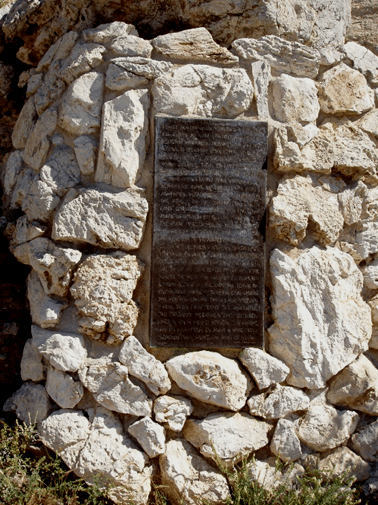
On the rocky hillside of Mars Hill in Athens is a bronze plaque on which is written, in hard to decipher Greek, the message of Paul to the members of the Areopagus. After seeking, alas in vain, to read the Greek and so to figure out what it was saying, a couple of us finally broke down and asked the tour guide what this plaque said. She told us to take out our Bible and read Acts 17 and to understand that inscribed on the bronze were the words of Paul which he had spoken on this spot.
It was on this spot that Paul had addressed the cultured despisers of all things Christian. Yet here was a marker that remembered Paul’s words from 2000 years ago. No one who was there that day can be named today except for two people. Paul was one of them. The other was Dionysius, a member of the Areopagus, who became a follower of Jesus through Paul’s preaching. Paul is remembered as the man who brought the message of salvation to the city and Dionysius is the one who listened. In Dionysius, the church of Athens took root. Today one of the main thoroughfares of the city is named in his honor.
It makes me wonder what sort of monuments I have established so that children, my own or others, would even ask, ‘What does this mean?” And can I explain to them that, on this spot, God invaded some new territory to claim it as his own? Or what new territory have I been involved in taking for the Lord? So much of what I have done over the years is in the realm of intangibles. How does one show that God has laid claim to this heart and that soul? How does one mark with a monument the preaching that invaded a person’s heart and their business was never the same after that?
I told some friends recently of a time when I had the privilege of speaking the word to a woman, Yvonne, and her husband, Leroy, and seeing God take hold of them just moments before Yvonne herself went to be with the Lord. Hanging on our living room wall is a gift from Leroy who died a few months later. “So Dad, why do you have that hanging there?” I think my kids know the story of God’s invasive love that laid claim to a woman in last hours of her life. Even if that isn’t remembered by anyone living after I have left the scene and the gift from Leroy that hangs on the wall is discarded as some old junk Dad kept, the Lord remembers and I give thanks for his invasive love every time I see it.

MT 7:24 “Therefore everyone who hears these words of mine and puts them into practice is like a wise man who built his house on the rock. 25 The rain came down, the streams rose, and the winds blew and beat against that house; yet it did not fall, because it had its foundation on the rock. 26 But everyone who hears these words of mine and does not put them into practice is like a foolish man who built his house on sand. 27 The rain came down, the streams rose, and the winds blew and beat against that house, and it fell with a great crash.”
I really don’t know what I imagined the Areopagus to be when I thought of it before. Now I know that “all” it is is a big rocky hilltop. These stairs lead up to the top of the hill from which one can see much of what the old city was. These stairs are not thought to have been present in Paul’s day, but, from my perspective, they are ancient– as in 1800 years or more old. The sign just to the right of the stairs tells people not to use the stairs since they are a good place to fall down; almost everyone I saw there were using the stairs to climb the rock. Once there, many simply sat and pondered.
When I read what Jesus had to say at the end of the sermon on the mount, I am reminded of this spot. For if one had a house built on this rock, no flood would reach it. It would stand firm in the midst of storms. And rising floods would never harm the hosue on this rock.
Jesus says that I can be like a man who built on such arock when I not only hear his words, but put them into practice. If I just listen and don’t practice them, I am like a man who built on the sand in the dry riverbed. It was a great view, until it started to rain. Then the water would get far too close for comfort and, in fact, would beat on the house and cause it to fall.
I have to ask myself, have I taken the sermon on the mount and actually put it into practice, or have I simply read it, applauded it, preached it, and then forgot it? As one preacher put it, did you ever stop to think how difficult it is to live the golden rule? To always treat others and I would desire to be treated is a challenge that not many of us ever live up to.
When I simply walk past the poor since I don’t have time for them today, I build on the sand. When I gleefully share the problems of a third person with another, I build on the sand. So instead, I need to begin to carve out steps up the rock. It’s more work. It’s definitely harder to do, but when I build on the word of Jesus to us in the sermon, I will build a house worth living in. Why? Because if my house crumbles in the storm, it’s not worth the effort. But if I go to the effort to build on the rock, it will stand for ages to come. I pray that I will be the one who heads up the rock and not one who is content on the beach.
Proverbs 9:13 The woman Folly is loud;
she is undisciplined and without knowledge.
14 She sits at the door of her house,
on a seat at the highest point of the city,
:15 calling out to those who pass by,
who go straight on their way.
:16 “Let all who are simple come in here!”
she says to those who lack judgment.
:17 “Stolen water is sweet;
food eaten in secret is delicious!”
:18 But little do they know that the dead are there,
that her guests are in the depths of the grave.
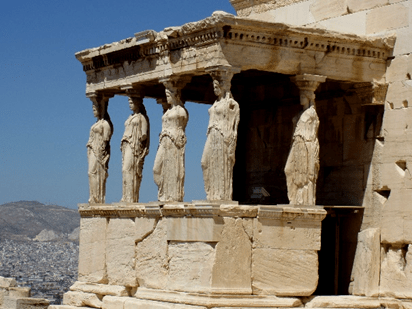
High on the Acropolis in Athens is the Erechtheum. A significant feature of this temple dedicated to Athena and the memory of her contest with Poseidon for the allegiance of the Athenians’ hearts is the porch of the Caryatids. The temple was built in about 400 BC. It is one of the more intriguing spots on the Acropolis. Each of the pillars for the roof of this porch is a carved statue of a woman. Each of them is unique even though the ones on the near side all have the same leg moving forward and the three on the far side have the other bent forward. Each seems to be inviting people to come to enjoy the cool shade of the porch they are providing by holding up the roof. The statues demonstrate the skill of the artist to create something beautiful.
Yet, one of the interesting features of this porch was that it was only accessible from the inside. Only those who were authorized religious figures could recline in the shade. It was an inviting place, yet was off limits. That helps me to understand something of how Solomon’s personification of Folly can be understood. The woman Folly has gone to the highest point of the city to call out to all the simple people, “Come to me!” But the problem is that no one can actually do that.
The promise could not be carried out. The promise was instead an empty invitation. In fact, as Solomon says, little do the simple know that the dead are there, her guests are in the depths of the grave? As this porch beckons to us to relax in the shade, little do we know that the dead are buried there. This porch is said to be the tomb of an ancient king of Athens.
There is something inside of me that says that deceptiveness is something to be avoided. I think that is what Solomon was saying as well. For in the early part of chapter four of Proverbs, he tells us of wisdom who has also gone to the highest point of the city and called to people to come to her and so to learn how to have understanding in life. I know this pushes the symbolism in ways that maybe no one else sees, but Solomon’s wisdom has sent out her maidens and hewn out her pillars which are seven in number. The porch of the Caryatids has only six. Isn’t that the way it always is with humanity? We, in our folly, always come up short of what God desires us to be.
Luke 14:28 “Suppose one of you wants to build a tower. Will he not first sit down and estimate the cost to see if he has enough money to complete it? 29 For if he lays the foundation and is not able to finish it, everyone who sees it will ridicule him, 30 saying, `This fellow began to build and was not able to finish.’
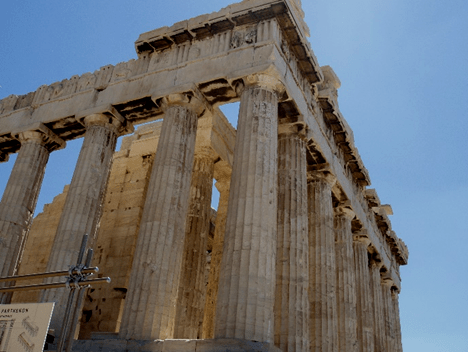
The Parthenon is the most important and characteristic monument of the ancient Greek civilization and still remains its international symbol. It was dedicated to Athena Parthenos, the patron goddess of Athens. It was built between 447 and 438 B.C. and its sculptural decoration was completed in 432 B.C. The construction of the monument was initiated by Pericles, then the king of the city of Athens, while the supervisor of the whole work was Pheidias, the famous Athenian sculptor. The story behind how Pericles could afford so monumental a project is fascinating to me. For it seems that as the Pan-Hellenic league pooled their funds in order to have enough money to face their foes, Pericles got them to store the cash in Athens. At which point, he undertook the erection of the Parthenon! He had taken account of whether he had enough cash to finish the tower and decided that with the aid of the other city states, he did have enough! So he built a famous landmark that has endured through earthquakes, wars, weather, and all the swinging of the pendulum of history to remain as a stunning work of beauty to this day. While it has deteriorated in many ways and been badly damaged in war and by theft, the Parthenon is a thing of beauty to savor.
The size of the Parthenon is what struck me as I stood on the Acropolis. It is a work of magnificent size that lifts the human spirit as we look at it. The work of the architect and sculptors is so pleasing to the eye that I was unable to stop looking and admiring what these men had done so long ago.
But then I stop to think of something else as well. Everything that I see was constructed by human beings from materials that were at hand. Sure, they had to move the marble from across the valley—no small feat!– but it was there to be used. Here on this mountaintop stands a temple to the goddess who was said to be a perpetual virgin whose role in human affairs was to bequest wisdom to her adherents. (More on this in another meditation.) Yet the God who has revealed himself to us in the Scriptures is the God who did not need to decide if he had the wherewithal to construct the whole universe. He simply spoke it into being. The temple of Athena took several years to build; the statue of Athena itself taking nine years. God simply spoke the world into being in his creation week of work. I think that the work of the Lord of heaven and earth is more awe inspiring and amazing even than the Parthenon, the work of human hands. I know whom I would rather worship!
Psalm 121
:1 I lift up my eyes to the hills–
where does my help come from?
:2 My help comes from the LORD,
the Maker of heaven and earth.
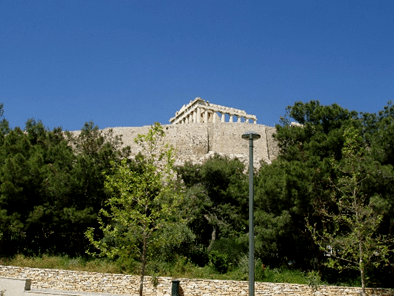
The psalms of Ascent, of which Psalm 121 is the second, were sung by the pilgrims heading to Jerusalem to worship the Lord God of heaven and earth. But on their way to the city of Jerusalem, they had to pass through a variety of places where one would lift up one’s eyes to the tops of the hills and see a temple or holy place or high place or sacred grove or such on the hill. As we learned in Greece, these high places were considered to be places that were near unto the God that was worshipped in that place. One went to these high places to receive insight into the working of that particular God and how to influence that God to bless me as a person. Wherever one goes in Athens, the Acropolis, with its temple to Athena, is visible in one way or another. We’re told that no building can be designed and built which would interfere with the view of the high place and the Parthenon that others now have.
So we need to ask ourselves, what do we make of that? The ancients often built their holy places so that they would be seen by others from a great distance. What do we build that others can see today? Our high places today are commercial buildings, high rise apartment buildings with high price tags, banks, insurance companies, big firms with lots of money. Government buildings housing offices of the people who run our communities rise above the skylines of the towns and cities in which they are found. Today, these are the places we turn to for help in times of trouble. Hospitals build towers that house various treatment facilities.
Is your company in financial trouble? Well, maybe you can get a government grant that will change things. Is your health failing? A modern tower of healing might be just the place for you to go to find help in this time of need. These places now tower over the skyline and form the places to which we look for help.
But the psalmist says, I lift up my eyes to the hills and I’m reminded that my help is not in any of these places that dominate the skyline. My help is in the name of the Lord, who made the heavens and the earth. Not long ago, I heard someone say that poets are the ones whose voices and verse shape our experience of reality. I think that is correct. For the poets help us to get a handle on our understanding of how things work. In our own day, just think of the power of songs—poetry set to music—to shape our understanding of our world. So here the psalmist, a poet, teaches us that the reality we all need is that the God who made the heavens and the earth is our only source of help.
We can lift up our eyes to the hills but we do not need the buildings on the hills, we need the name of the Lord our God. Nothing and no one else will actually see me through in my journey of faith.

Psalm 102:24 So I said:
“Do not take me away, O my God, in the midst of my days;
your years go on through all generations.
:25 In the beginning you laid the foundations of the earth,
and the heavens are the work of your hands.
:26 They will perish, but you remain;
they will all wear out like a garment.
Like clothing you will change them
and they will be discarded.
:27 But you remain the same,
and your years will never end.
:28 The children of your servants will live in your presence;
their descendants will be established before you.”
In the entry to the Acropolis in Athens stand some mighty gates. These were used only once in four years as part of a great festival. Today, tourists by the thousands stream into these gates and gawk at the workmanship of those who laid the foundations for the columns that grace the entry. One wonders, at least I did, how did they do this? They did not have the modern laser-guided transits that would have been very useful in laying out the site. They did not have the powerful cranes we would use today in building so grand a structure. They didn’t have any of our modern tools. Yet, they accomplished something wonderful.
I was intrigued by this section of the Propylaea which shows the effects of an earthquake on the entry gates to this holy mountain. The second section has shifted out of sync with the column’s radius. It has become a bit of the evidence of how perfectly crafted the columns were that make up the Acropolis’ buildings. Each piece was so carefully prepared that it rested on top of the one below so tightly that no mortar of any sort was used to help them to match up. They were carefully ground to fit each other and so to be solidly settled on each other. One might say that these columns were established upon the mountain in such a way that they would remain forever.
But an earthquake happened and the columns that are so heavy and so perfect began to sway and the perfection of the workmanship was shown to have not been able to withstand the foundations of the earth shaking. In fact, says the Psalmist, the very foundations of the earth will one day wear out and be replaced by the one who made them in the first place. They will wear out like an old shirt and be discarded so that something new can happen.
When I look at myself, I see that my life is like this column in the Propylaea. I have some parts that are in line and in order; then there are other parts that have shifted out of line and out of the place they need to be. My life has its precarious points. I know they are the ones which are founded and built on the foundations of this world that are shifting and wearing out. So I pray that God will fulfill in me his word that says in Christ I am a new creation. God will always remain solid for us. He is the only foundation worth building on.
Acts 17:22 Paul then stood up in the meeting of the Areopagus and said: “Men of Athens! I see that in every way you are very religious. 23 For as I walked around and looked carefully at your objects of worship, I even found an altar with this inscription: TO AN UNKNOWN GOD. Now what you worship as something unknown I am going to proclaim to you.
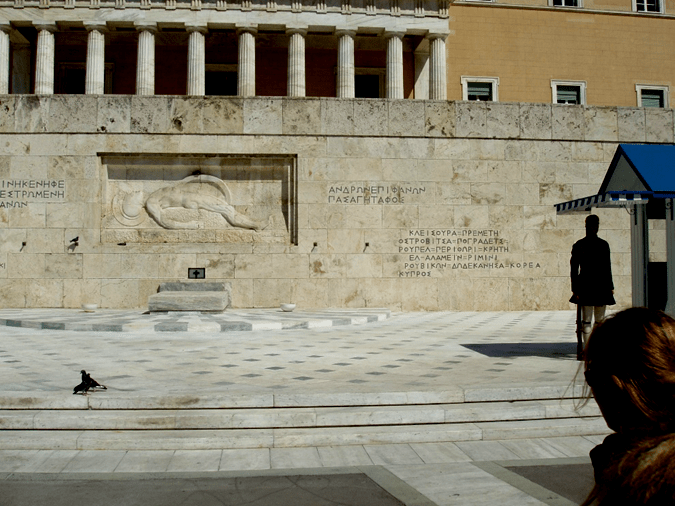
In many nations the task of guarding the tomb of the Unknown Soldier is one entrusted to a few people whose lives will revolve around doing that job and nothing else. So too in Greece, here at the tomb of the Unknown Soldier the nation is represented by a group of young men who stand guard day and night. They do not allow any distractions to keep them from their appointed task. I have to admit that I wondered how they could keep their focus so well that the antics of those who sought to take pictures next to them did not break their concentration for a moment.
It was an interesting remark that our tour guide Christiana made when she said, “the Greeks are, as a people, fascinated by the unknown. Just as Paul found an altar to the unknown God, the Greeks have always been eager to discover the unknown.” She made the case for their ancient high culture being brought about by this desire to know that which is just beyond the realm of knowledge as it had progressed so far.
It seems to me that many of us are intrigued by the new and the unknown. We want to know more and more; but at the same time, we recognize that an insatiable desire to discover that which is unknown isn’t always healthy. In our day, the desire to know how cloning might work and what it might be like to have a clone of oneself isn’t always a wise course of action. We need the wisdom of God to know what our limits are.
Mankind, in our desire to be as God, will push the limits of any boundary just to find out if there might be some unknown God that exists just beyond our knowledge. The problem is that God has already made himself known to us in his Son Jesus, but we still want to know if just maybe there might be another unknown out there. Mankind is always dangerously toying with the tower of Babel by which we will make a name for ourselves and keep from being scattered across the face of the earth. God wants us to know him in Christ. To have the personal knowledge of the one named Jesus who has taken on the forces of evil and who, though he died, lives again to give us the life we long for.
PS 144:9 I will sing a new song to you, O God;
on the ten-stringed lyre I will make music to you,
:10 to the One who gives victory to kings,
who delivers his servant David from the deadly sword.
:11 Deliver me and rescue me
from the hands of foreigners
whose mouths are full of lies,
whose right hands are deceitful.
:12 Then our sons in their youth
will be like well-nurtured plants,
and our daughters will be like pillars
carved to adorn a palace.
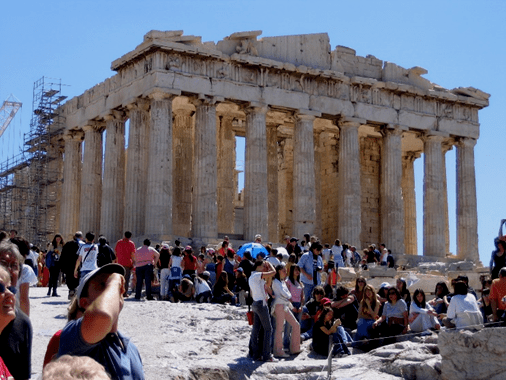
When I stood on the top of the Acropolis in Athens, I was joined in that by hundreds of others. Maybe the numbers even went into the tens of hundreds. All of us were there to admire the graceful work of people who had labored in love for Athena about 2500 years ago. As the tour books all say, this is one spot in Greece you don’t want to miss. Therefore, every tourist makes a pilgrimage to the mountain, climbs the steps to the top, and gazes at the massive marble pillars; their graceful appearance even after all these centuries very apparent. There are no straight lines in the construction of the Parthenon, despite the apparent symmetry. All columns narrow slightly to create a visual harmony. The Parthenon was built with a marble that contains some iron. This causes it to glow with a subtle golden color as the sun sets.
David seems to have had just such a place in mind when he wrote the poetry that is quoted above. In that verse, he praises the Lord who gives victory to kings. Then he speaks of how the sons of the peaceful land would be like the well-nurtured plants that filled so many valleys around Israel. And the daughters of that people would be like pillars carved to adorn a palace. The pillars that were carved for the Parthenon are so carefully constructed that they give to the visitor today a very pleasing feel.
In my experience, there has not been such a delicate delight as the Psalmist reports in the work of an architect or an artist. In fact, the arts of almost all sorts (the one exception being “sacred” music) are looked at with some skepticism. And at worst are dismissed as mere fluff. Therefore, the arts have been denigrated as a profession. Perhaps, though, it was because, in my own history, there has not been the sort of skill available to have pillars be carved in such a way that they bring a soaring sensation to the spirit of the observer.
Yet I am also aware of the joy there is in seeing the youth of a community grow into young adults with all the beauty of life pulsing in their bodies. This is no doubt, a gift of God. This is the gift of God in giving the necessary peace which makes possible the care, the nurture, and the feeding of the youth that will have them emerge into adulthood with grace and strength. When we see youth well-provided for, may we join in giving thanks with David for the gifts of God which have made this possible.
Genesis 3: 8 Then the man and his wife heard the sound of the LORD God as he was walking in the garden in the cool of the day, and they hid from the LORD God among the trees of the garden. 9 But the LORD God called to the man, “Where are you?”
I was speaking recently with a pastor friend of mine who said he was going to do a sermon series on the times when God asks questions and waits for us to answer. It begins here in Genesis 3. It begins, I notice, when Adam and Eve head off on their own and God has to come looking for them.
God had, from the time of creating mankind, come each evening to walk in the garden with his image bearers. Adam and Eve would have had God’s friendship each day, their own private quiet time with God. But one day that all changed. And God suddenly became a sinister person, a being to be avoided. So they hid. Yet, it is remarkable that God doesn’t come snarling into the garden asking in a roar, “What have you done?” No, he comes with a quiet call, “Where are you?”
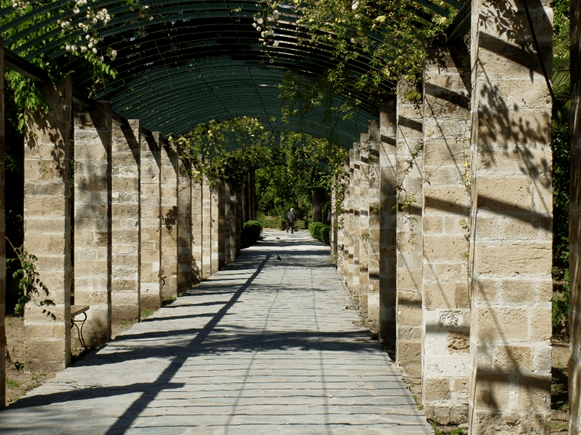
In downtown Athens is a quiet spot of retreat for the mangy dogs that roam the city’s streets. It’s called the National Gardens. Of course, it was planted for people, not for what in Greece is not man’s best friend. The National Gardens have many places of quiet for people who are in need of a place to think or just relax. It’s interesting to me that for a man or a woman to find a place to think and to get away from it all, we turn to an urban oasis like a garden. Or one can simply stroll down the shady arbor and discover that plants and their aromas clear the mind and stir the soul.
I and inclined to believe that God put the first two people in a garden because of just that reason. When we look at the mighty branches of trees, smell the aroma of flowers in bloom, hear the songs of multiple species of birds, touch the cool stones underfoot, and taste the flavor of a breeze that stirs the hair on our heads, then we know there is a God and he calls us to believe and listen for his voice calling to you and me, “Where are you?”
The answer we give to that question will shape our experience of God for all our lives. He doesn’t demand or coerce. He simply loves us back to himself so that we may be whole. He invites us to come walk with him again. When was the last time you did?
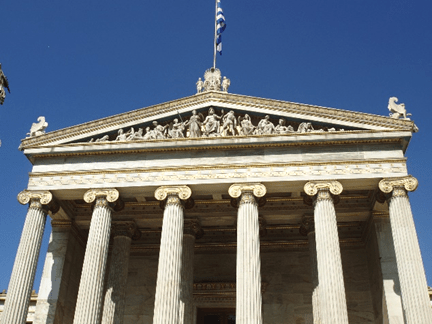
Acts 17:22 Paul then stood up in the meeting of the Areopagus and said: “Men of Athens! I see that in every way you are very religious. 23 For as I walked around and looked carefully at your objects of worship, I even found an altar with this inscription: TO AN UNKNOWN GOD. Now what you worship as something unknown I am going to proclaim to you.
As Paul made his way around Athens he became more and more convinced that he was among a people who were very religious. It was not difficult to discover what it was that made him think that. This is a photo of one the Athens University buildings that was constructed in the 1800’s in the “classical style.” Part of what that means is that it includes a pediment (the triangular area above the columns) where a depiction of the Greek pantheon is to be found. The twelve gods of the pantheon are arrayed in various poses to depict their place in the scheme of things. The depictions of these gods were found in a great many places around Athens as Paul made his way around the city as a tourist. The most important of the gods would be found in the center and the lesser ones would spread out from the center to either end.
Paul, as he makes his way around the city and observes all the idols, cannot keep his mouth shut. He soon begins to interact with the people he finds in the marketplace as he tells them that he has news for them about the God whose altar he found. It was inscribed to an unknown God. Paul soon runs into the guys who spent a great deal of their time in Athens thinking about philosophy and religion. The professional thinkers in this regard became members of what is known as the Areopagus. This was not only a hill on which they held their meetings; more importantly, it was the court of appeals for faith and philosophy. Here the official members of the Areopagus would listen to presentations from visiting professors of philosophy and make judgments regarding whether these ideas might continue to be taught on the hallowed ground of the ancient city known for wisdom, i.e. Athens. For, we are told, all the Athenians and the foreigners who lived in Athens spent all their time doing nothing except listening to the latest ideas. It was, indeed, the forerunner of the modern university!
So Paul seizes on the opportunity to announce the good news of Jesus to these men who sat in judgment on the latest ideas. To Paul this was much more than an idea. It was a faith that touched one’s very life in all its aspects. To the Athenians, this was another in a series of new ideas to be intellectually debated and verified or rejected. So Paul has his work cut out for him. While they are very religious, the listeners do not think their faith has any holes in it. Except for that one God they did not know. But they already had twelve and the pediments of all their public buildings depicted these gods for them. What could Paul have to say that would interest them? Just this: the God you don’t know is seeking you out and he is not a God made of stone. He is present in Jesus Christ. He is calling you to repent of service to those gods of stone. Now, that was news!

Proverbs 11:1 The LORD abhors dishonest scales,
but accurate weights are his delight.
Proverbs 16:11 Honest scales and balances are from the LORD;
all the weights in the bag are of his making.
Proverbs 20:10 Differing weights and differing measures–
the LORD detests them both.
Proverbs 20:23 The LORD detests differing weights,
and dishonest scales do not please him.
Four times, count them, the writer of Proverbs makes very clear that the Lord does not take any perverse delight in seeing someone using deception in transactions. The photo is of a set of weights from the marketplace in Athens. Just like the gas pumps I pull up to so often, they carry a stamp that insures that the office of weights and measures has approved the use of these weights. If one were in the market and the person weighing out the spices used his own weights, one could request that the weighing be done again, this time with official weights. It makes the transaction so much less stressful. I know I am getting what the other says I am.
I thought these weights were so fascinating. Here was a collection of weights that had been officially certified to be accurate. These were not just the results of a committee of commerce at Athens. No, these were from the Lord. Proverbs tells me that all the weights in the honest person’s bag are from the Lord. He is the one who is behind honest transactions. He is the one who desires to have people be honest in the way they treat one another.
When I was in high school, we used a balance type of scale in chemistry and physics classes. I remember how difficult it was to not cheat on the weighing process in order to make our experiments turn out the way the book predicted it would. We knew what the end was supposed to be, but if we didn’t get the correct solution, it was easy to blame our weighing process. So, we would work backward from where we were supposed to arrive and “fix” the weights we had started with. In high school chemistry that is not so significant, but it showed me how readily one could try to fix the weights so that we could achieve a desired end.
As a pastor I don’t deal with the official standards of weights and measures, but at the last day, in judgment, I will be weighed in God’s scales. Only with Jesus at my side will I not be found to be lacking in everything worthy of heaven.
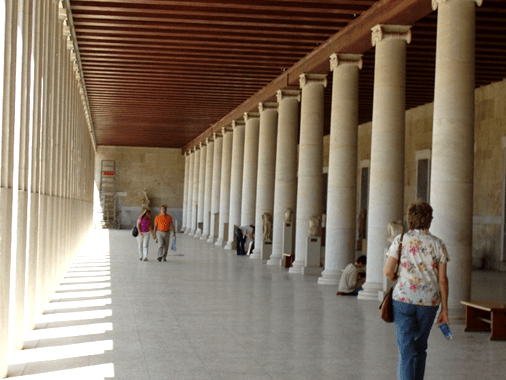
Acts 19:8 Paul entered the synagogue and spoke boldly there for three months, arguing persuasively about the kingdom of God. 9 But some of them became obstinate; they refused to believe and publicly maligned the Way. So Paul left them. He took the disciples with him and had discussions daily in the lecture hall of Tyrannus. 10 This went on for two years, so that all the Jews and Greeks who lived in the province of Asia heard the word of the Lord.
In Athens, we visited a restored stoa (pronounce it slowly as if with a heavy southern accent and you’ll hear our modern English word). In this covered colonnade area when Paul was in Athens, the merchants of the marketplace would have spread their wares in the areas between the pillars. There is a second story above this one as well. It seems that it was in just such a second story in the city of Ephesus that Paul did his teaching in the lecture hall of Tyrannus. What I learned was that in many of the Mediterranean areas, the people take a break from the day’s heat for a few hours each afternoon. So Paul would have had access to a lecture hall since it would not have been in use as a school during those hours of the afternoon. Furthermore, he had the opportunity to have quite a crowd of listeners since many people would have been looking for the shade and the lecture hall provided just such an opportunity.
What this impresses on me is how important the marketplace was to the mission of Paul. It was in the marketplace that he found his listeners. It was in the language of the marketplace that he wrote his letters to the churches which we call a part of the New Testament. It was the marketplace where the ideas of the culture were discussed. It was in the marketplace that Paul could arrange for a hearing for the Lord.
Something has happened over the centuries. Today we in North America no longer find the ambassador of the Lord in the marketplace. The pastor is in a church building. That building is normally empty for most days when people are at work. It is used most on the weekends when people are not working. The most significant issue for me, however, is that the gospel is not a part of the marketplace anymore. We have hidden the good news off in places that the common non-Christian doesn’t go to.
Paul went fishing for the Lord in the place where the fish were to be found. We hope the fish will come to the pond where we have the lines in the water. If they don’t, we don’t know quite what to do. And the good news kept a secret from those who need it in the marketplace of their lives. I wonder what Paul would say of the way we try to get the message of salvation out to others. Would he think we are doing our best when we only teach in our church buildings and not in the markets?
EX 15:1 Then Moses and the Israelites sang this song to the LORD:
“I will sing to the LORD,
for he is highly exalted.
The horse and its rider
he has hurled into the sea.
:2 The LORD is my strength and my song;
he has become my salvation.
He is my God, and I will praise him,
my father’s God, and I will exalt him.
:5 The deep waters have covered them;
they sank to the depths like a stone.
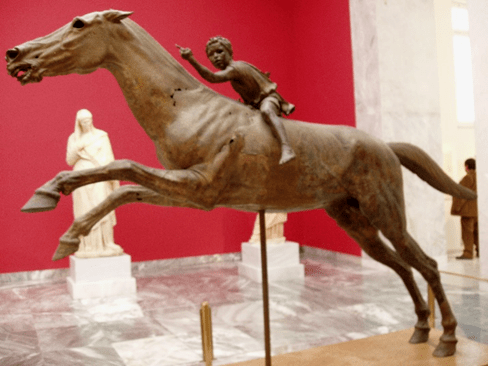
I know my pastor friends would tell me that I am making quite a stretch on this one, but I couldn’t help but think of the song of Moses and Israel when I heard the story of the jockey. This bronze statue of a horse and rider was found in the depths of the sea. The statue is known officially, I believe, as the bronze jockey of Artemision because it was found off the coast of that city. He likely was holding the reins in his left hand and a whip in his right hand. The date given by historians for its casting is somewhere about 140 B.C. Since it was lost at sea for centuries, it was protected from destruction.
So in a way the song of Moses isn’t all that appropriate, I suppose. They sang that song because, when God had thrown the horse and rider of Pharaoh’s army into the depths of the sea, the people of Israel had been protected from destruction. Yet I find it a quirky coincidence that a shipwreck that happened, most likely, when the statue was being stolen and transported to a new country by the victors, God threw it into the depths of the sea and it sank like a stone to the depths. Only in the depths of the sea could this remarkable thing of beauty be preserved for us to enjoy today.
I am convinced that God is the one who holds the reins of history. He directs all our experiences to his ends. Just as the jockey who holds the reins of the horse uses them to direct the course that the horse runs, so too God holds the reins of history to direct it to where he is going to take history. It is my firm conviction that history does not run free with no guidance from a sure hand on the reins.
I’m reminded as well of God’s words to us in Psalm 32 where he calls to us and says, now don’t be so dense of mind that I have to use a bit and bridle on you like that of a horse which has no understanding. So God wants me to be more like the jockey than the horse. The jockey knows where the race is going and directs his horse in that way. Even if I do not respond, the Lord will still be the one who triumphs gloriously. He might just throw the horse and rider into the sea again if he has to! He will be the one who directs the course of history, much to our chagrin. (Or much to our delight.) It all depends on if we want to be on the Lord’s racecourse.
2 Corinthians 4:1 Therefore, since through God’s mercy we have this ministry, we do not lose heart. 2 Rather, we have renounced secret and shameful ways; we do not use deception, nor do we distort the word of God. On the contrary, by setting forth the truth plainly we commend ourselves to every man’s conscience in the sight of God. …. 5 For we do not preach ourselves, but Jesus Christ as Lord, and ourselves as your servants for Jesus’ sake. 6 For God, who said, “Let light shine out of darkness,” made his light shine in our hearts to give us the light of the knowledge of the glory of God in the face of Christ.
:7 But we have this treasure in jars of clay to show that this all-surpassing power is from God and not from us.
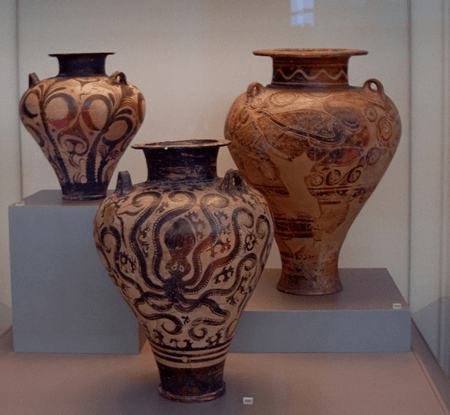
In our travels around the country of Greece, we visited many museums. In each of them were examples of the beautiful handiwork of ancient artisans in the making of jars of clay. What was so amazing was how easily these jars were made. One needed good soil, some water and skill and, behold, a ceramic piece could be built. From there it was decorated and fired. Pictured here are some pots in the archaeological museum of Athens. The center one is “a three handled Palace Style amphora with three large octopuses within a marinescape of rocks and seaweed. A Mycenean imitation of the Minoan Marine Style … 15th century B.C.” Let’s see, these jars of clay are from about 3500 years ago. They have withstood the ravages of time by being buried in a tomb with provisions for the life that was to come.
In our culture today, we find that death is something to be avoided at all costs. Yet there is the old joke about life being a genetically based terminal disease that affects 100% of the population. It seems as though we have come to believe that only this life matters. Even though we may occasionally acquiesce to the facts of death and taxes; we would much rather pay taxes than face death, unpleasant as those taxes may be. The good news is that there is a life that comes after death. It can be a life that is filled with peace, joy, and love. Actually a life filled with the presence of God. We who are Christians have that treasure in us, jars of clay that we are.
That is the term Paul uses in his letter to Corinth. The reason he said this was because most of the jars of clay that were apart of his life, were ones that did not last long. They may have been beautiful, wonderfully made and all. But hit them with a hammer and they would shatter and the contents would spill out. Only those items carefully buried would survive. Maybe that was what he was thinking of. When the storms of life hit us, the treasure will spill out. Then others will know that the treasure is for them, too, not just for those buried away in a church somewhere where nothing can harm them!
Revelation 21:1 Then I saw a new heaven and a new earth, for the first heaven and the first earth had passed away, and there was no longer any sea. 2 I saw the Holy City, the new Jerusalem, coming down out of heaven from God, prepared as a bride beautifully dressed for her husband.
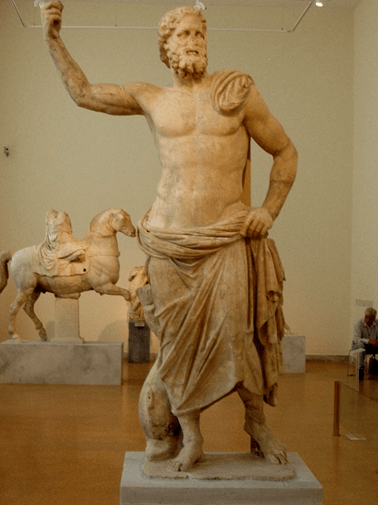
Poseidon was the God of the sea in the Greek pantheon. Here he is shown with some clothing on, but a more typical statue of Poseidon was nude. Also, in his right hand would have been a trident, his usual weapon of choice. He is shown in this pose from about 100 B.C. in a more relaxed position. Why? His seaways were, by this time, dominated by Roman men-o-war. He was, therefore, sidelined with no one to threaten or challenge anymore. He had, we might say, become obsolete.
When I read the book of Revelation chapter 21, I see that Poseidon will really be obsolete in the world that is to come. In fact, the sea he had been said to control with his awful weaponry will be no more. That is quite a statement for John to make as he is sitting in a cave on Patmos, an island surrounded by the sea which served as a barrier to any who might desire to flee the exile they had been placed under when sent to Patmos. So John in his vision sees the new heavens and the new earth and he sees no need for fearing the sea nor any reason to have the sea serve as a way to enforce exile anymore. The sea which swallowed ships and human beings; the sea where great whales frolicked and scared people half to death; the sea was no more.
Even in our own day, one of the most feared weapons of the sea is the Trident Nuclear submarine force. From most anywhere undersea the Trident can be launched against its target. It is a tribute to the power of the Greek myths that their imagery and mood is still in use today in western culture.
But I am also intrigued by the idea that God’s word takes on the imagery and ideas of the culture of its day and declares that in the world to come, the God we serve will not only take away Poseidon’s power, but will eliminate his very realm. The sea which so often threatened us human beings will no longer have the upper hand. The sea, which in our experience on December 26, 2004, rose up and destroyed hundreds of thousands of people and their villages and cities, will be no more. The sea which spawns hurricanes which devastate the land will be no more. The sea which harbors the sharks that strike with vicious power will be no more. The sea and all its dreadful power will not be a part of the new world. Only God, the true God, will rule in grace and peace.
Genesis 1:27 So God created man in his own image,
in the image of God he created him;
male and female he created them.
Genesis 2:25 The man and his wife were both naked, and they felt no shame.
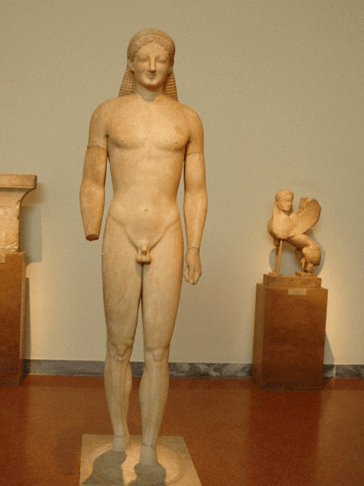
The Greeks were masterful at doing sculpture. Everywhere we went there were statues that graced many of the temples and significant city monuments. One of the more intriguing aspects of the statues is the fact that in the early era of Greek sculpture, the male form is normally found nude and the female form is found fully clothed. The statue that is pictured here is one that was found in the temple of Poseidon at Sounion. The statue is about nine and a half feet tall. His size is similar to that recorded for Goliath as he faced off with David (I Samuel 17).
As the ancient Greeks sought to honor their gods, they would make these statues which are thought to have been made in the image of Apollo. Although that idea is debated, one can see in the image an attempt at portraying what the gods looked like. For, upon careful examination, the kouros, as statues of this sort are called, is not really like a human being. In fact, this cannot have been a sculpture that is based on a human being since the proportions are not like any human being that exists. The following paragraph is from a college handbook about the kouros sculptures:
“The sculptor uses .. divisions of the body to establish a set of rigid proportions based on simple mathematical relationships. Most obviously, the width of the figure is equal to its depth and approximately one quarter of its total height. The body is proportioned so that the distance from the base of the foot to the base of the knee cap is also one quarter of the figure’s total height. This one to four proportion based on the total height is also found with the distance between the navel and the chin, and between the top of the head and the base of the neck at the clavicles. The latter relationship makes the head itself one sixth of the statue’s height. Far larger in proportion than one observes on the actual human body, the height of the kouros’s head corresponds exactly to the width of the figure at its hips.”
Mathematics as the basis for how a figure is made would have been exciting to the Greeks who were adept at discovering mathematical concepts. But, and here my confidence in the Scriptures comes out, God in creating humanity, made us in his own image. He also forbids us to seek to make an image of him. Why? Because when I look in the face of another human being I am to see the face of God. God’s image is a living breathing person. Today we are clothed because of our sin and the distance that has put between us. God in Christ has bridged that distance and now we know him personally again as we did at the very beginning.

Acts 18:18 Paul stayed on in Corinth for some time. Then he left the brothers and sailed for Syria, accompanied by Priscilla and Aquila. Before he sailed, he had his hair cut off at Cenchrea because of a vow he had taken.
Any time Corinth is mentioned in the book of Acts, one needs to think of sailing. Corinth was a very important shipping center. It became that because it was located on a narrow strip of land that separated the Aegean and Adriatic seas. Corinth was a strategic center for the transmission of the good news of Jesus to much of the ancient world since so many people passed through the city on their way from one area to another.
Already in 600 B.C., the tyrant of Corinth, Periander, wanted to dig a canal but realized that it was going to require more human and economic capital than he had. So instead he built a four mile road that ran over the isthmus. Ships would then unload their cargo at one end of the road. It would be carted across the isthmus and loaded onto another ship, thereby saving several days of sailing all around the Peloponnesian peninsula. With all the shipping that passed over the road, Corinth became a very cosmopolitan place. In the years that followed, a movable trolley system was constructed that made it possible to actually hoist the ship itself onto the road for the short journey across the isthmus.
Naturally, this required a great deal of labor. So the city of Corinth grew to about 300,000 in its heyday. When Paul arrived it was a thriving city at its height of influence and population. He stayed in the city for about 18 months before deciding to sail for Syria once again.
The city of Corinth had within it a church that had been founded by Paul. Over the years he would make a few visits to Corinth and would send them two letters that became a part of the canon of Holy Scripture for the Church. It has been said that Corinth was one of Paul’s most difficult churches but it also seemed to be his favorite. In the letters, we can tell that he had a very warm relationship with the church in Philippi, but First Church Corinth was the one that he thought about a great deal.
First Church Corinth had its problems, but it just showed all the more brightly how great God’s grace was. It was the church that seemed to savor its life in Christ in a free-spirited way that sometimes got in the way of real discipleship. They needed to realize the wonder of the communion they shared in Christ at the Lord’s Table and so we have teaching about that in chapter 11 of I Corinthians. It was the church that needed to learn to love each other and so Paul teaches us all about that love in chapter 13 of I Corinthians. If it weren’t for those problems in First Corinth, we might never have had those beautiful teachings. I am privileged to live in a place where I see many sailing vessels. I think of Corinth when I see them and give God thanks for one such as Paul.

2 Corinthians 5:1 Now we know that if the earthly tent we live in is destroyed, we have a building from God, an eternal house in heaven, not built by human hands. 2 Meanwhile we groan, longing to be clothed with our heavenly dwelling, 3 because when we are clothed, we will not be found naked. 4 For while we are in this tent, we groan and are burdened, because we do not wish to be unclothed but to be clothed with our heavenly dwelling, so that what is mortal may be swallowed up by life.
In the museum at Corinth, there is this grave bed which was found in one of the tombs of the city. A body would be carried into the tomb and laid on this bed with the head resting on the raised pillow area. We were wondering why the two slabs were separated by a couple of inches. What I can discover is that the bed could have been structured in this way to allow the decomposing body to fall down below the level where the bones would remain. A grave was visited after five years to see if the body had totally decomposed. If it had, then the bones were collected, washed in wine, and placed in a container separate from the bed which would then be available for another person’s body to be laid in state.
When the Greeks would speak of death, it was only in harsh terms. They looked at death as the enemy of mankind and it was not to be desired. However, we are told, if it was time for someone to die, then so be it. The spirit would then leave the body and travel to the realm of Hades where it would live as a disembodied phantom, recognizable but not corporeal. This was not a state to be desired, but it was a better alternative to remaining trapped in the body forever.
It was to this culture that Paul wrote his letter that we know as Second Corinthians. In it he includes a beautiful section on the truth of what happens after one dies. He speaks of the earthly tent we live in which was how many of the Greeks would have also referred to their bodies. But he says that if this tent is destroyed, we have a heavenly house made by God that is eternal in the heavens. I find it challenging to my own understanding of life after death, to hear him describe this body as a tent as compared to the house, a permanent structure, which God has prepared for those who long for his appearing.
When we look at our funeral practices, we can tell something about our own understanding of life and death and life after death. It is my hope that as I seek to help my fellow believers through their grief that I point them in the same direction as Paul did the Corinthians. Our great need is for hope in life everlasting. Paul shows us that in Christ, we will have it indeed!
Acts 18:12 While Gallio was proconsul of Achaia, the Jews made a united attack on Paul and brought him into court. 13 “This man,” they charged, “is persuading the people to worship God in ways contrary to the law.”
:14 Just as Paul was about to speak, Gallio said to the Jews, “If you Jews were making a complaint about some misdemeanor or serious crime, it would be reasonable for me to listen to you. 15 But since it involves questions about words and names and your own law–settle the matter yourselves. I will not be a judge of such things.” 16 So he had them ejected from the court. 17 Then they all turned on Sosthenes the synagogue ruler and beat him in front of the court. But Gallio showed no concern whatever.
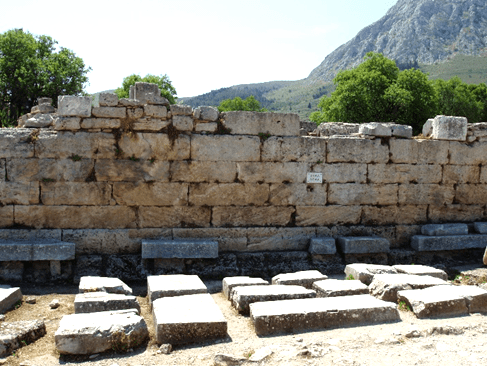
The courtrooms of Paul’s day were a great deal different from what we have in our world of North America. The courtroom of Corinth was in the public marketplace where a large stone pedestal had been built and on it the chief justice of the region sat and held court. In Paul’s day, that person was named Gallio. The time that he was the proconsul can be dated rather accurately since it lasted about a year. The year that is given for Paul’s appearance in court in Corinth was 52.
He would have stood in front of the stone wall, as it appears in the photo, to be tried by Gallio who would have been sitting atop the bema as it was known. The Jews who were tired of Paul’s teaching decided that the time had come to take some decisive action against the missionary. So they hauled Paul in front of Gallio to have Paul, it seems, declared a threat to the peace of the city. Thereupon, he would have been hustled out of Corinth and told never to return again.
But the plan didn’t work. Their charges that Paul was teaching something that was contrary to the law could mean that he was messing up Judaism or it could mean that Roman law precluded his teaching about Jesus. Gallio, an eminent proconsul whose reputation was respected throughout imperial Rome, decided that this was an internal matter of religious preferences. So he had them thrown out of court.
What happened next was a real boomerang event. For the crowd in the marketplace saw this as an opportunity to deal a severe blow to the Jews of the city, so they grabbed Sosthenes, the synagogue ruler, and beat him right there in the marketplace within the line of vision of Gallio. But Gallio turned a blind eye to what they were doing. This event helped to solidify Paul’s position as a teacher of a new form of Judaism which gave Christianity a little bit of protection under the law. He used it well for the rest of his life.
 Sermons and Meditations by Bob Zomermaand